Visual Editing for a Composable Storefront
Migrating Big Ass Fans to Contentstack and enabling Visual Builder–powered in-context editing to give marketing direct control that serves direct-to-consumer audiences.

Big Ass Fans is a globally recognized manufacturer of high-performance fans and lighting solutions, serving commercial, industrial, and residential customers around the world. As Big Ass Fans expanded into direct-to-consumer markets, the company's legacy WordPress and Optimizely content platform couldn't keep pace with the new ambition. Big Ass Fans partnered with Orium to migrate the content layer to Contentstack as part of a composable commerce architecture — modernizing how content is modeled, edited, and delivered across both B2B and direct-to-consumer audiences.
Partners involved:





The Challenge
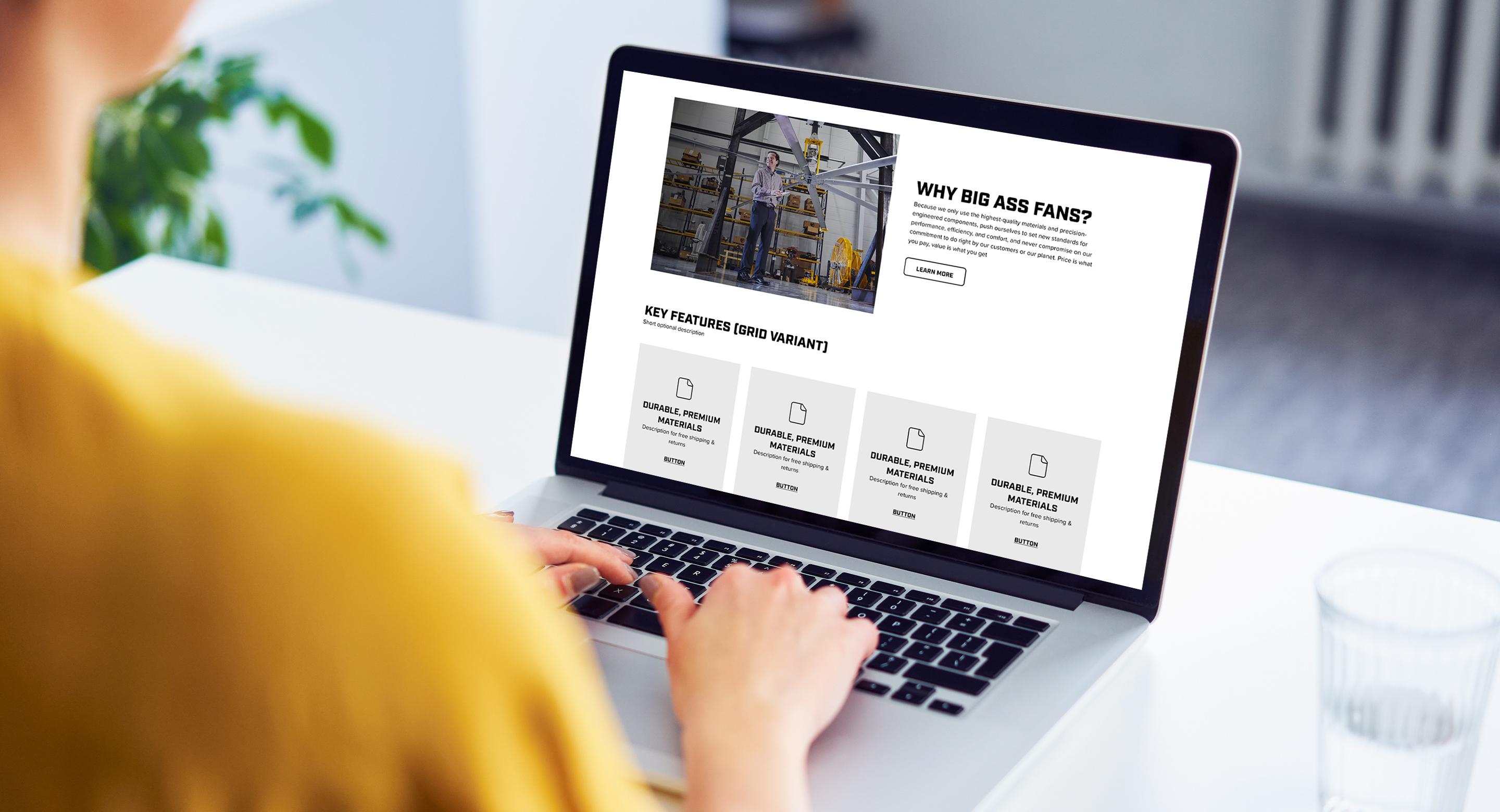
Big Ass Fans had a story to tell, and increasingly, a story to tell to a different audience. As the B2B manufacturer expanded into direct-to-consumer markets, the constraints of its existing WordPress and Optimizely content platform became impossible to ignore. The legacy CMS had served the prior business but wasn't built to support the kind of product storytelling, structured content, or editorial agility a modern commerce experience required.
Content teams faced a familiar legacy-CMS problem: every edit meant opening a form, hunting for the right field among dozens, making the change blind, and then previewing the result to see what had actually changed. The disconnect between what editors were editing and what customers would see slowed every campaign and made content iteration disproportionately expensive.
Layered on top was a structural challenge. Big Ass Fans needed to serve a direct-to-consumer audience with a model flexible enough to support multiple regions—the US at launch, fast-followed by Canada, Australia, and Singapore—multiple languages, and the brand's signature product storytelling. The new content layer also had to integrate cleanly with the assets in Big Ass Fans' existing Acquia DAM and with the data flowing from a new BigCommerce Catalyst commerce layer, without becoming a maintenance burden as the business grew.
The Strategy
From the outset, Orium and Big Ass Fans approached the content migration as a structural shift, not a like-for-like replacement. The right move was to design a content model fit for Big Ass Fans' expanded ambitions, one that could serve DTC from a strong foundation, scale across regions and languages, and give editors direct control of the experience they were building.
The content strategy was developed alongside the broader composable architecture work. A dedicated CMS EventStorming session, run during the Align phase, mapped the content team's workflows, surfaced the gaps between how content was created today and what the new platform needed to support, and aligned stakeholders on the content model before a single component was built. That investment in upfront alignment paid off downstream in fewer late-stage content surprises.
Two principles shaped the build. First, treat the content model as a first-class deliverable, designing structured content types that could be reused across DTC contexts without duplication. Second, lean fully into Contentstack's editor-experience capabilities—particularly Visual Builder—to give Big Ass Fans' content team the in-context editing experience the legacy CMS couldn't provide.
For our content team, the move to Contentstack changed what was possible day-to-day. Editing happens in place, content reuses across audiences, and our team can finally focus on the work that matters.
The Solution
Orium delivered a composable content layer built on Contentstack, designed to serve direct-to-consumer audiences from a single structured foundation. The new storefront combines Contentstack as the headless CMS with BigCommerce Catalyst on the commerce side, deployed on Netlify and integrated with Big Ass Fans' existing Acquia DAM for asset management.
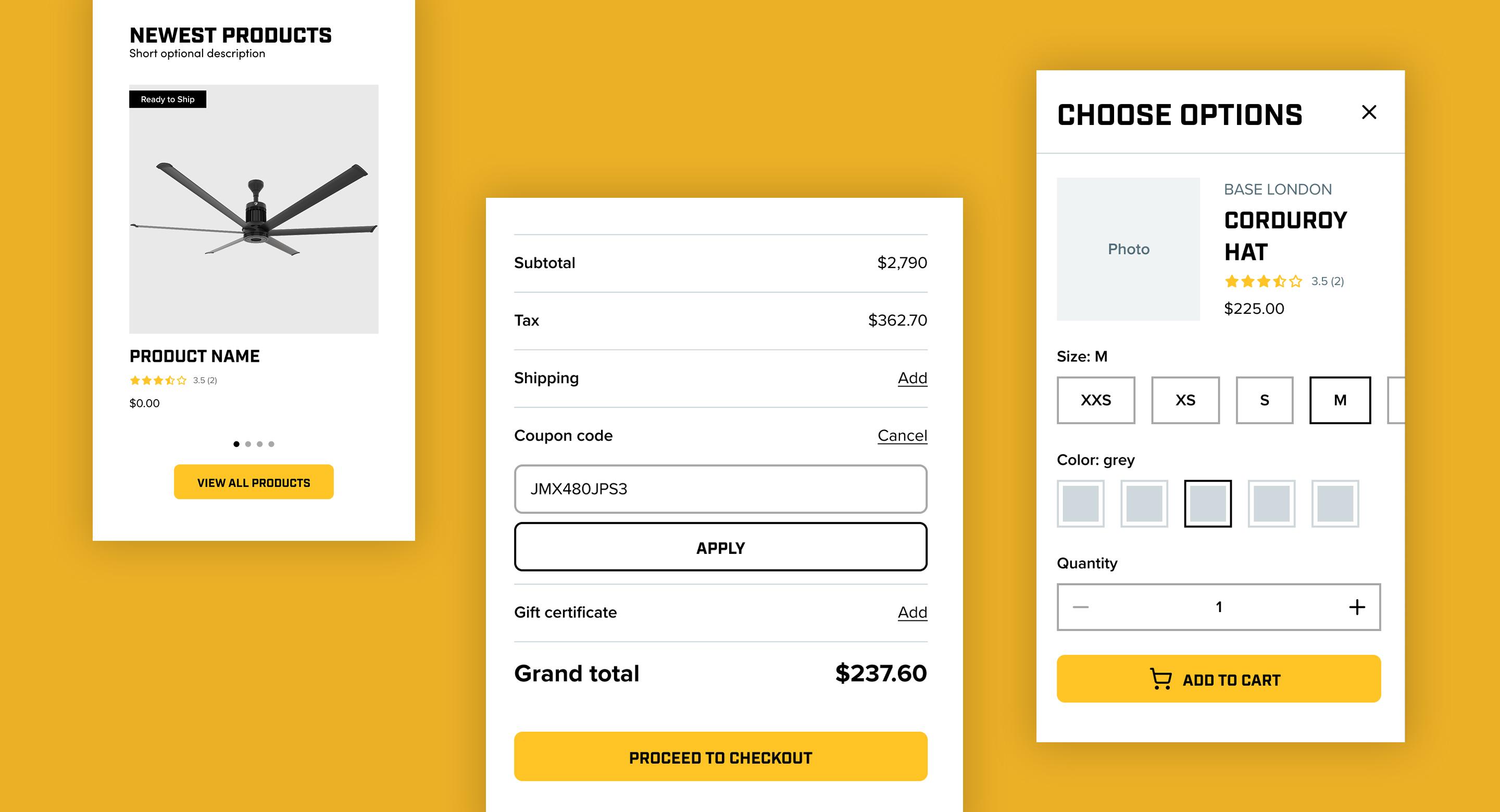
At the foundation is a structured content model designed for reuse. Banners, hero modules, interactive elements like accordions and tabs, cards, rich text blocks, and product carousels are all defined as modular components that can be composed into pages and reused across markets and audiences. Multi-language support is built into the model from day one with the framework to expand into additional languages and regional contexts as Big Ass Fans' geographic expansion progresses.
The most distinctive piece of the implementation is the Visual Builder integration. Orium instrumented ~18 storefront components with Contentstack's Live Preview (CSLP) edit tags, making editorial fields—titles, eyebrows, descriptions, CTA labels, images, rich text, and video URLs—editable directly in Visual Builder. The result transforms the editor experience: content teams can now open any page in Visual Builder, click directly on the element they want to edit, and make changes inline or in a focused sidebar panel, with the change visible in real time, exactly as the customer will see it.
To support Visual Builder's requirements for typed URL fields, Orium designed new content type definitions and a migration approach that preserves URLs, localized variants, and personalization integrity through the transition.

Outcomes & Next Steps
With launch in Spring 2026, Big Ass Fans went live with a composable content layer that brings the brand's product storytelling directly to consumers without compromising the operational rigor required of a B2B manufacturer. The new content layer gives Big Ass Fans' marketing team the in-context editing experience they needed to iterate quickly, a structured content model that scales across audiences and regions, and a foundation that supports continued growth for Big Ass Fans for years to come.
Looking ahead, they can continue building out multi-region capabilities, deepening the structured content model as new audience segments come online, and continuing to refine the editor experience as their needs evolve. With the experience in place, the content team finally has a platform built for the way they actually work, and the room to focus on the storytelling that connects to customers.