Accelerating Developer Productivity With Context-Aware Tooling
An MCP-powered developer experience to deliver speed, clarity, and confidence across Fluent Order Management workflows.
Fluent Commerce is a global leader in distributed order management, powering complex fulfillment operations for enterprise retailers and brands. As the platform's flexibility and configuration depth expanded, they partnered with Orium to explore how agentic technologies, specifically the Model Context Protocol (MCP), could simplify the developer experience, reduce overhead, and empower teams to build with greater efficiency and speed.
Partners involved:





The Challenge
AI can be a powerful accelerator for engineering teams, but it isn't turn-key— especially in nuanced domains like enterprise order management. LLMs often struggle to produce accurate GraphQL queries, even with a schema available. And when it comes to vendor-specific building blocks like workflows and rules within Fluent Order Management, the models tend to guess their way through, filling in the blanks with whatever seems plausible.
As Fluent Commerce expanded the platform's configurability, both the opportunity and the risk grew. AI could help reason over workflows, surface dependencies, and propose safe changes, but only with guided, context-rich access to the system instead of whatever snippets developers happened to copy from consoles, docs, and repos.
The core challenge became helping developers understand, modify, and validate OMS behavior with less effort, and without sacrificing precision. The key question was whether MCP could provide the missing context-aware layer that turns AI into a meaningful, trustworthy assistant instead of a confident guesser.

The Strategy
Fluent Commerce partnered with Orium to build a development MCP server that could materially reduce developer friction and increase developer efficiency at scale. Rather than jumping into a full redesign of the developer ecosystem, the teams aligned on a strategy designed to validate impact and gather real-world feedback.
Two key hypotheses guided the work:
- MCP could act as a bridge between developers and system context, making it easier to explore rules, workflows, and queries through natural language.
- Embedding MCP directly into existing tooling—specifically the Fluent CLI—would increase adoption and minimize setup overhead.
The collaboration centered on building a local MCP server, integrated into the Fluent CLI and compatible with MCP-aware IDEs like Claude Code, Cursor, and others. This would allow developers to use plain language requests like:
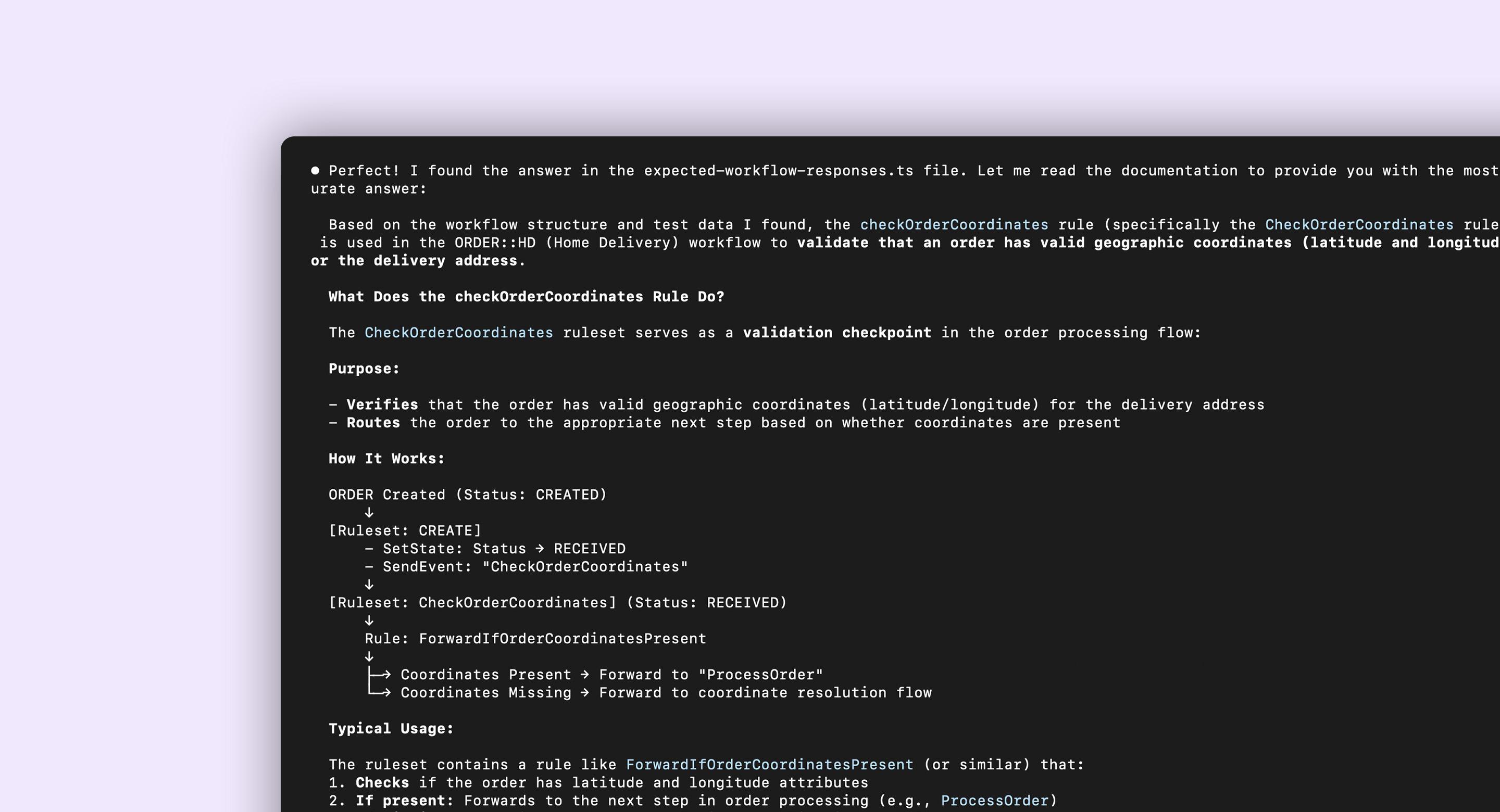
- "What does this rule do?"
- "Generate a valid GraphQL query for this scenario."
- "Add a fraud-check step to this workflow."
The goal was not to replace developers, but to collaborate with them: validating changes, generating tests, and accelerating tasks while keeping the developer firmly in control.
Our initial work with Orium on the local MCP server showed us how we can evolve the Fluent builder experience. The goal was to optimize the agentic tools our partners and customers are using today—starting small, proving value, and building toward a smarter, more intuitive future.
The Solution
With the project goals defined, Fluent and Orium built the MCP server through a phased, stackable design. Instead of introducing a single monolithic capability, the teams created a local intelligence layer that understands a developer's context and connects it to Fluent Order Management through the Fluent CLI. Each layer unlocked the next, moving from simple query generation to full workflow comprehension.
The foundation was a GraphQL-aware engine that understands Fluent schemas and conventions. Developers could describe what they needed in natural language, and the MCP server generated structured queries, validated them against the schema, and removed much of the trial-and-error that typically happens in the CLI or IDE. This became the read/write backbone for all higher-level reasoning.
To that backbone the team added a rules layer, enabling the MCP server to locate and interpret existing rules, explain behavior in plain language, and help developers evolve or create rules safely. It also generated unit tests aligned to Fluent's recommended practices. Because it was grounded in real data and real queries, the system's explanations remained accurate and contextual.
The final layer focused on workflows. The MCP server mapped existing flows, highlighted branching logic and dependencies, and let developers adjust or insert steps conversationally. Rule creation and reuse happened automatically where needed, and workflow updates were validated through the same recommended practices-aligned testing approach. This gave developers a clear, end-to-end view of operational logic.
Across all layers, the MCP agent followed a consistent collaboration model: analyze the current state, propose a plan in natural language, confirm it with the developer, then execute and validate the changes. Acting as a copilot rather than a black box, it lowered effort while preserving ownership and transparency.
The system remained intentionally lightweight and local, giving Fluent tight control over the experience while keeping partner adoption friction low. And because everything runs through the Fluent CLI, partners could experiment safely within their own environments without touching production systems.
Phased Delivery
The project unfolded over twelve weeks, with each phase building directly on the last.
Weeks 1-2
Established the GraphQL foundation, enabling natural-language query generation and schema validation inside the Fluent CLI.
Weeks 3-6
Expanded into rules, adding discovery, explanation, safe modification, and automatic test generation.
Weeks 7-10
Added workflow comprehension and modification, giving developers a conversational way to navigate and adjust complex operational flows.
Weeks 11-12
Focused on stabilization, performance tuning, and preparing the MCP server for real-world use.

Outcomes & Next Steps
Early results from the pilots show that MCP meaningfully changes how developers work with complex enterprise systems. In one Orium project, a task that enabled specific logic through a workflow and its dependent logic went from roughly ten developer days of analyzing, modifying, and testing to about two, an improvement of around 80% (~5x faster). Similar gains appeared elsewhere, with less context switching, quicker rule and workflow iteration, more consistent implementation quality, and faster onboarding. Taken together, these results show that MCP gives Fluent a strong foundation for the next generation of agentic IDEs and AI tooling.
Preparation for general availability in 2026 is already in progress. By validating the MCP server in real-world environments and building on an open standard, Fluent is laying the groundwork for a more adaptive developer experience where developers and intelligent tools work together to configure systems with greater speed and confidence.
The future of enterprise development isn't just composable. It's contextual.